
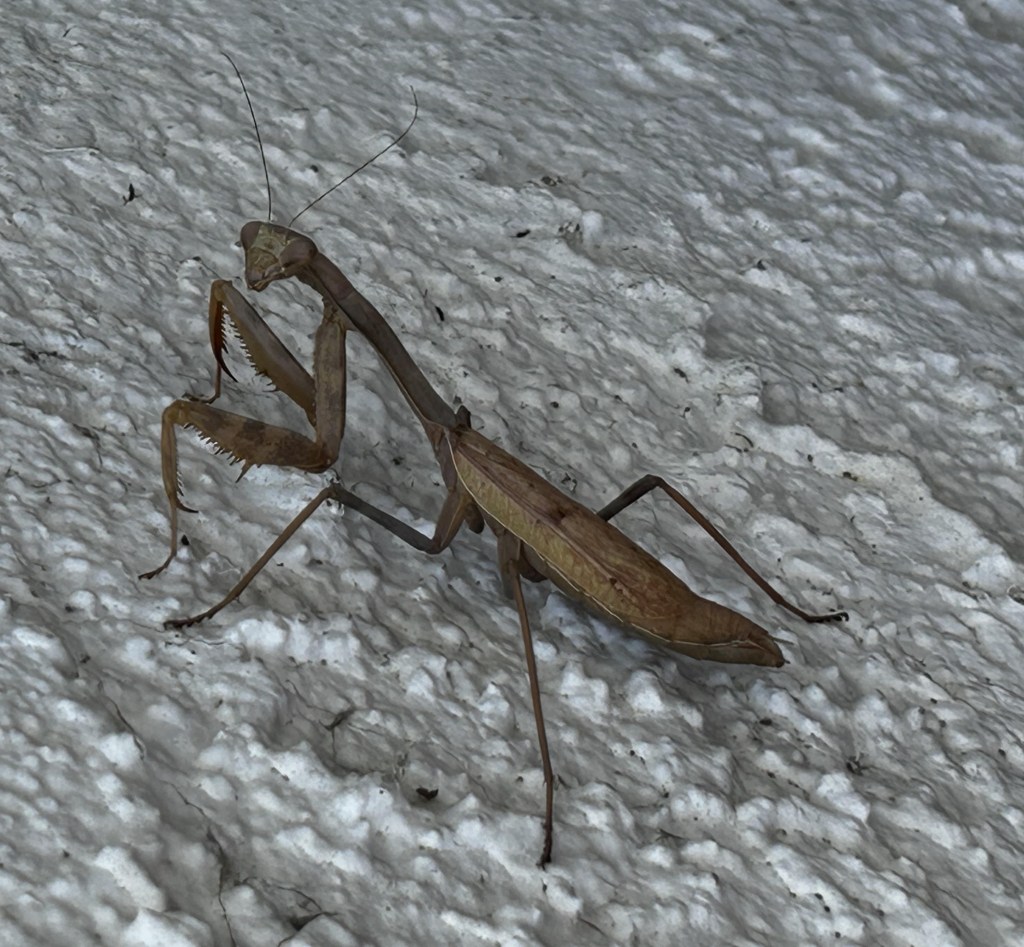
This insect was perched on the patio wall, keeping perfectly still when I reached for the garden hose. Thinking it was a leaf that had blown in with the recent Santa Ana winds, due to its color and body shape, I turned away. A second look revealed that this four-inch-long creature was not a storm-tossed leaf.

After submitting photos to iNaturalist, I learned that this a Bordered Mantis. It is one of three native species of mantid found in California. These insects are found in the southwestern United States and northern Mexico.
Looking closely, the domed eyes on the head of an elongated body reminded me of a Giacometti sculpture. However, the forelegs (front femurs) with their saw-like appendages really caught my attention. They are stout compared with the two rear pairs of legs. A 2017 paper in the National Library of Medicine refers to them as: “The raptorial forelegs are complex structures variably armed with spines, crenulations, tubercles, and setae.” Wow!
The abdomen has hued striations of color that would be right at home on a desiccated eucalyptus or olive tree leaf.
Eating is an exercise in patience. Mantids’ strategy favors staying stock-still, waiting for their meal to arrive on the flower or plant on which they have patiently perched. Their diet includes butterflies, bees and wasps.
Mantids are among the largest insects, with a lifespan of one year.
 Mashabu