On a recent morning in the Santa Ynez Canyon, as I was looking toward Topanga State Park, two native trees stood out. A ribbon-like stand of California Sycamores in the creek bed contrasted with the lush greenery of the upland Coast Live Oaks.

The sycamores, like some oaks of the savannah in the Midwest, keep their leaves until spring. These leaves rustle against each other, their color somewhere between amber, honey, and pale peach.
The bark color is stippled, broadcasting Henri Matisse-like shapes in a melange of ecru, beige, gray and light brown. It can have the appearance of jigsaw pieces nestled together on the trunk.
Like willows and cottonwood trees, sycamores are happiest near water and frequently found in riparian woodlands. Their deep roots anchor the trees during flash floods and high wind events, and support them during droughts.
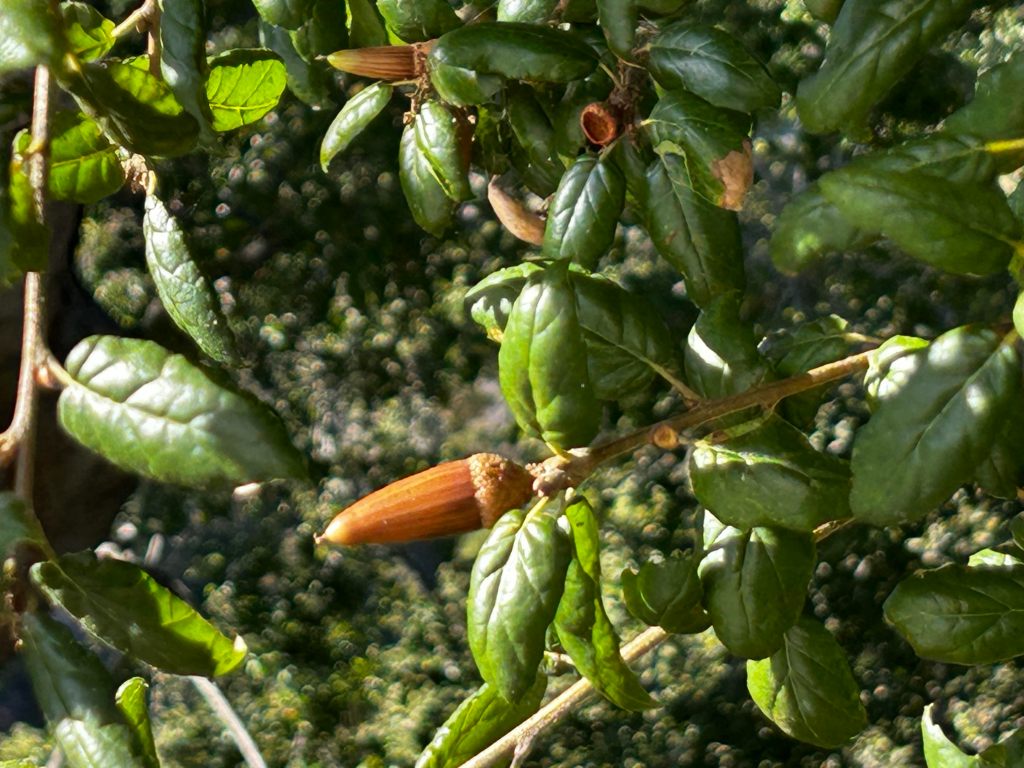
The Coast live oak is classified as an evergreen. Its lush green leaves are 1 – 2.5 inches long and spiny, bringing to mind holly branches. One could say it is the Southern California tree companion to the Giant Redwoods and Sequoias of Northern California’s coast. All enjoy coastal fog and tolerate fires well.
Native American people, including the Chumash and Gabrielino-Tongva nations who called this part of the state home before explorers arrived, harvested acorns and made powder for use in stews and bread making.
Within the Santa Monica Mountains National Recreation Area, there are ten native trees which contribute mightily to this unique ecosystem: box elder, big leaf maple, alder, California walnut, California sycamore, cottonwoods, coast live oak, valley oak, willow and California bay laurel.
What kind of work do these trees perform? “Native trees are keystone species, supporting thousands of species of insects, amphibians, reptiles, birds and mammals.” (Los Angeles County Native Tree Priority Planting Plan, p. 11). “The value of the ecosystem services provided by trees can be quantified with tools that measure benefits such as air quality improvements, energy conservation and temperature moderation, stormwater runoff avoided and stored, as well as carbon storage and sequestration” (p. 17).
We frequently see Acorn Woodpeckers, American Crows, Common Ravens, and Allen’s and Anna’s Hummingbirds alighting in the green forest in the park.
Some things to consider when visiting Los Angeles County beaches are the quality of the water and air which are impacted by inland ecosystems. After significant rains, the Department of Beaches and Harbors publishes water quality results, frequently advising people to stay out of the water due to stormwater runoff contamination. Who knew that the Malibu Creek, Topanga Creek, or Santa Ynez Creek help mitigate the ocean’s contamination after wet weather?
In his book, Bringing Nature Home, Douglas Tallamy imparts an important ecological lesson: planting native species supports the local ecosystems in a myriad of ways. Not surprisingly, these local oak trees support over 40 members of the butterfly and moth family. In particular, the Western Swallowtail Butterfly depends on the leaves of the California sycamore during its caterpillar stage.
Though the leaf is fallen, the bud is set for spring.
 Mashabu
Wow, beautiful view… Hear more rain is coming your way. The hills will be green… Good luck on your surgery (soon, now, right?)!
LikeLike