Please sit down with a mug of tea and have a relax.
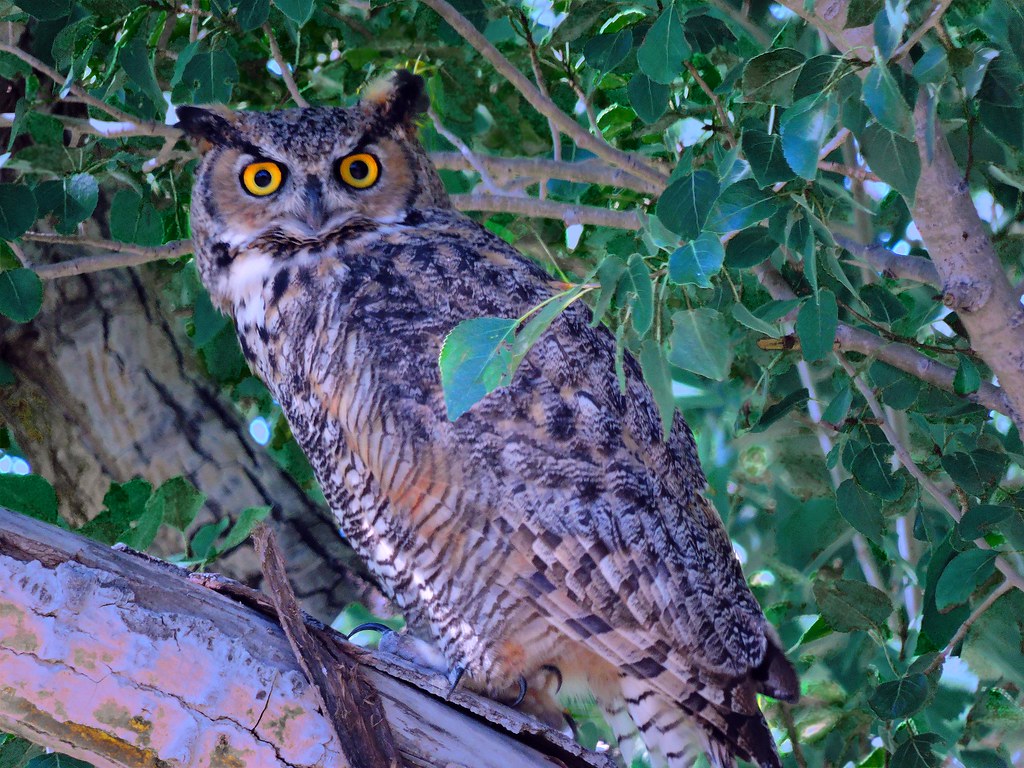
After three years of hearing but never seeing Great Horned Owls that were calling from the pine stand on neighbor Bob Dylan’s property in Malibu, we were delighted to hear these crepuscular (active at twilight) birds hooting in our new home in the Highlands of Pacific Palisades. It wasn’t ‘til last Saturday night that we had the good fortune to see one of the owls calling from a tall pine tree in Topanga State Park just after sunset.
Bob heard the call from behind closed doors and stepped out to catch the concert. Standing on the crown of the tree at 10 o’clock (if you imagine the shape is a clock face), the concert master appeared to bow its head down and raise its tail feathers with each call. Click here to watch it and turn up the volume. For a superior viewing, check out this link and this video, both from Cornell University’s All About Birds program.
As I was making this video, I heard two distinct responses to the featured owl: one down the canyon and louder, and the second uphill which was quieter. Was this a courting call, given the time of year, or was it parents talking to their offspring?
Volunteers at the University of Minnesota’s Raptor Center have the opportunity to learn about owls, falcons and hawks from world-class educators. Here are a few fun facts gleaned from my time there.
EARS & EYES
Great Horned Owls’ ears are located asymmetrically on the head: one ear is slightly higher on the side of the head than the other. This allows for triangulation of sound using each ear and their facial disc feathers to guide the owl, using those noises to determine the precise location of their next meal.
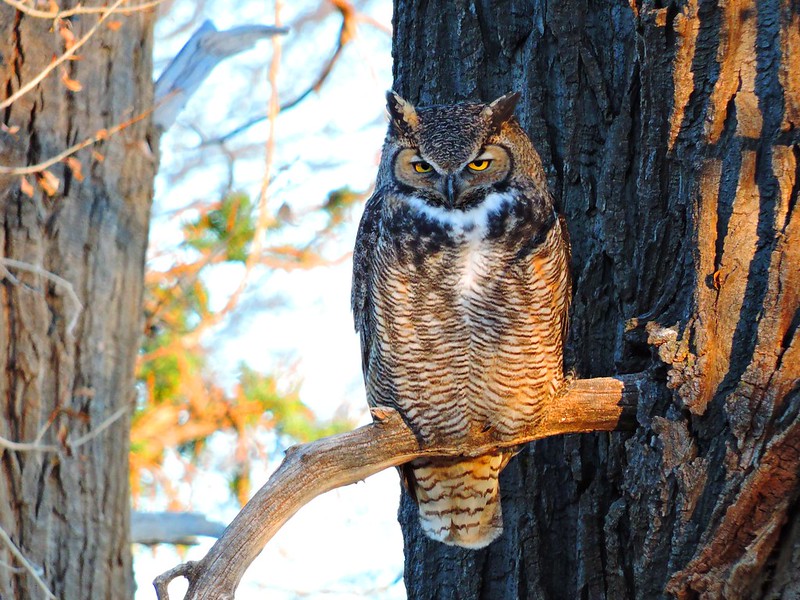
And those feathers that we might think of as ears at 10 and 2 on the top of Great Horned Owls’ heads? They’re actually tufts of feathers to camouflage them during the day when they are roosting and sleeping.
In the bird world, night feeders have evolved vision which complements their acute hearing: their eyes have binocular vision. And what do they find to eat with those superb eyes and ears? “Great Horned Owls have the most diverse diet of all North American raptors. Their prey range in size from tiny rodents and scorpions to hares, skunks, geese, and raptors. They eat mostly mammals and birds—especially rabbits, hares, mice, and American Coots, but also many other species including voles, moles, shrews, rats, gophers, chipmunks, squirrels, woodchucks, marmots, prairie dogs, bats, skunks, house cats, porcupines, ducks, loons, mergansers, grebes, rails, owls, hawks, crows, ravens, doves, and starlings. They supplement their diet with reptiles, insects, fish, invertebrates, and sometimes carrion.” (Source: All About Birds at Cornell University)
CASTING PELLETS
After eating rodents, they regurgitate the fur and bones as a pellet, which makes sense as those parts offer no nutritive value. Maybe you’ve encountered these furry, oval or finger-shaped objects on your nature hikes.
At the U of MN Raptor Center, the pellets are removed from the mews (enclosures) of the educational ambassador birds and put into an autoclave. Sanitized, they are available to purchase at the Raptor Center for those who want to further their knowledge of small rodent anatomy!
OWL THREATS
After the 2018 Woolsey Fire in Malibu, the Thorne Family Farm noted the Great Horned Owls’ absence in the presence of more animals eating the farm’s produce. On a visit one Saturday during Covid, the good news was the return of the Great Horned Owls to nest and survey the fields for meals and by extension, increase the yield of crops. But fires are not the only challenge for owls, hawks, falcons and vultures in this part of California. Rodent killing schemes are deployed in many cities. (You may see the little black boxes outside of buildings where you live). In response to that, the City Council of Malibu banned the use of rodenticides in 2019, effective September 2021.
UC Davis sums it up this way: “Raptors are exposed to rodenticides when they ingest poisoned rodents. Poisoned prey animals may exhibit erratic movements, which attract the attention of hunting raptors. The buildup of residual toxins can lead to high mortality rates for raptors and decrease their populations. Toxins can also make exposed individuals more susceptible to fatal hemorrhage due to minor trauma or predispose them to death from stressors such as starvation or disease.”
Chances are if you’re farming seed crops and produce, and have Red Tailed Hawks and Great Horned Owls in your vicinity, you will not have a rodent problem. The Hawks are the daytime clean up crew, and the owls will take care of things from dusk to dawn.
STATS
- The species’ range is nearly all of North America (excluding the tundra) and a portion of South America. Great Horned Owls tend to be homebodies. Unlike other raptors and many bird species, they don’t need to migrate in winter to find nourishment.
- With a wingspan of 42-55 inches, you might reasonably think that you’d hear such a bird in flight. In fact, their feathers are shaped to support silent flight, all the better to catch dinner by surprise.
- By weight, they are the largest owl in North America. Only the Great Gray Owl is taller, but it weighs less.
SPOTTING OWLS
Feathers offering visual camouflage, and daytime sleeping can make it a challenge to spot owls. Unexpectedly, you may have an ally or two in the corvid family. The next time you’re outside, should you happen upon a flock of crows or even blue jays harassing and dive bombing a bird in a large tree, you may be rewarded to notice that it’s a roosting owl that they want to eject from their neighborhood.
FEATHERS
The National Audubon Society has this to say about owls’ silent flight: “They have large wings relative to their body mass, which let them fly unusually slowly—as slowly as two mph for a large species like the Barn Owl—by gliding noiselessly with little flapping. Additionally, the structure of their feathers serves as a silencer. Comb-like serrations on the leading edge of wing feathers break up the turbulent air that typically creates a swooshing sound. Those smaller streams of air are further dampened by a velvety texture unique to owl feathers and by a soft fringe on a wing’s trailing edge. These structures together streamline the air flow and absorb the sound produced.”
A RADICAL THOUGHT
All this talk about wings reminds me of Bernd Heinrich’s books about Ravens and Golden Crowned Kinglets in which he suggests that birds’ wings did not support flight initially. Rather, they were an extra layer of warmth which evolved into flight feathers. What a radical thing to contemplate! Here’s a helpful tutorial from All About Birds if you’re keen to read more about this.
To learn more, check out raptor resources near you. Here are some ideas to get you started:
CALIFORNIA
The Ojai Raptor Center in southern California has a well-regarded education and rehabilitation program.
UC Davis is home to the California Raptor Center.
MINNESOTA
In the southeastern corner of the state in the Driftless Zone, the International Owl Center in Houston, MN has a range of programs including their popular Owl Prowls.
The University of Minnesota’s Raptor Center is a leading global center of education for veterinarians and the public. Founders Dr. Patrick Redig and Dr. Gary Duke literally wrote the book on how to care for raptors in the early 1970’s.
NEW YORK
Cornell University’s All About Birds site and Merlin app are tremendous resources for curious birders of all stripes.
Each of of these resources are supported in part by contributions from the public and would welcome financial help in their missions to care for injured raptors and educating future veterinarians and the public.
Where are your regional raptor resources?
 Mashabu
Capital A Awesome! I’ll start circulating it now.
LikeLike